
How To Reach Apo Island, Philippines
Introduction
This article covers how to get from Siquijor Island to Apo island and Apo island to Moalboal or Cebu including prices and tips.
When I first started writing about Apo Island this whole article was meant to just fill the ‘how to get there’ section. However, it has ended up being way too long for that so here is the full detailed guide – how to get to and from Apo Island in the Philippines. When I started researching this route, I couldn’t find much information online so I hope this will help someone else in a similar situation.
If you want to know why you should visit Apo Island then read my other blog.

Siquijor to Apo Island
When arriving in Siquijor from Cebu we didn’t know how we were going to get to our next destination – Apo Island. One thing that six months of travelling in Asia has taught us though, there is always a way. If its budget friendly or comfortable, that is a another thing.
On day one of arriving in Siquijor we asked our homestay host for advice. This is one of the big benefits of homestays over hotels, they are a great source of local information. Hotels tend to only promote their services or private services that are often more expensive. Plus the locals way is normally more fun.
The only way I could find online to book this route ahead of time was to get the ferry to Dumaguete city, where the ferry drops you at Dumaguete Port. You then need to get a jeepney (Philippines version of a mini bus) to Malatapay Wharf to get a locals boat over to Apo island. This is not impossible (we actually did part of this route in reverse coming back) but it is time consuming and could lead to you paying a lot for a private boat to Apo island. This is because there is no official boat service from Malatpay to Apo island so you need to arrive early to secure a locals boat. This means leaving Siquijor on the earliest ferry to get there as early as possible. Alternatively, if you have more time and a looser itinerary you could break this up with a night in Dumaguete City which would allow more flexibility and you could get to Malatapay Port earlier.
Skip to part two if you want to read about this part of the journey or are trying to get to Apo island directly from Cebu.
So under instruction from our homestay host we set off into town to find a direct route to Apo Island.
Option 1 – Coco Grove Beach Resort – A very fancy hotel in Siquijor which was quite the opposite to our island accommodation. I do wish we had the budget to have stayed here as even the reception screamed luxury with a sign for ‘bbq and live music on the beach tonight’. Anyway, the hotel runs a tour to Apo island, so for a fee they will let you hitch a ride and be dropped off on the island instead. This cost 2400 pesos (£29.58) (for two people) and you just book at reception. This service is popular as the hotel prioritises their guests so book as soon as you get to the island. We had to join the waiting list but did get a text the day before to say we had a spot.
Option 2 – Island Vibes Explore Diving Centre – They run day tours to Apo Island for snorkelling and diving. They used to let you book just a taxi service but due to restrictions on the number of people allowed on the island you must join the tour for the day and then you get left on the island after. I didn’t think this was too bad of a deal for 2550 pesos (£31.50) (each), you got a full day guided snorkelling at different spots and lunch. You could also pay 4800 pesos (£59) for one dive or 6,000 pesos (£74) for two dives. Then you get dropped off on the island after, I suppose in theory you could pay this and not actually do the tour when you arrive if you really didn’t want to. If you are a diver and want to experience some diving on the island, then you could do this and then still spend two nights on the island – the best of both worlds. However there is a dive shop on the island, so you should compare prices. Now we have been and know you don’t need to pay a local guide to snorkel on the island I don’t think it’s as good value, but you can make your own mind up.
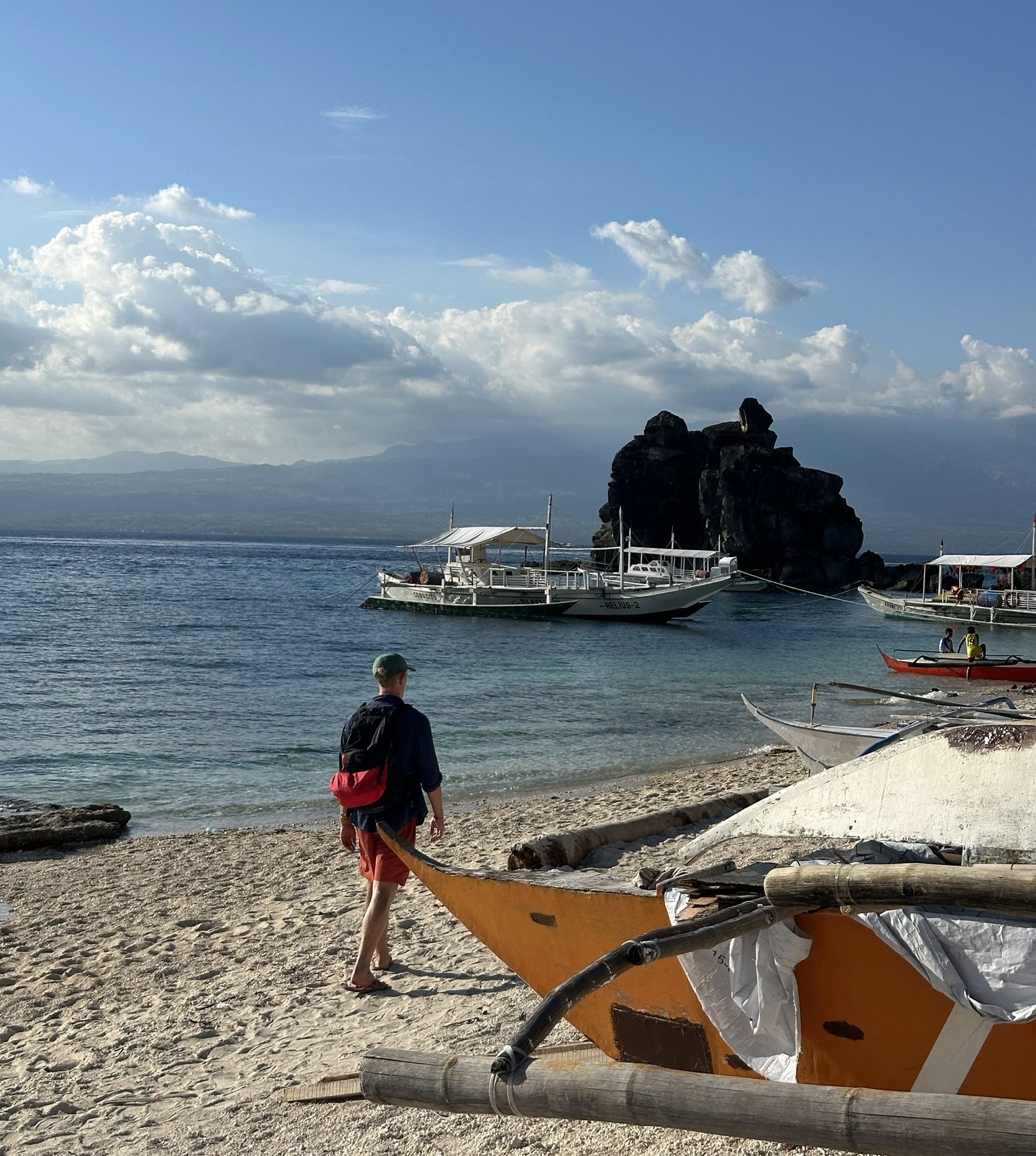
We ended up going with Option 1. We simply arrived at the Tambisan Port for 7am and then arrived at Apo Island. Always check which port you are going from in Siqujior as there is a few and it might change where you want to stay the night before.
From Apo Island to Moalboal
Elnor our amazing homestay host arranged our boat back to Dumaguete from Apo Island for us which was 600 pesos (£7.40)(for both of us). We did overhear some other travellers who were having to get a private boat the same morning, I don’t know how much they paid but I imagine a lot more. This is just one of the many reasons to stay at Elnor’s. I imagine other homestay hosts would do the same on the island but if you are getting expensive quotes its worth stopping by Elnors, even if you’re not staying as she is very friendly and helpful. The boat we got was just a local commuter’s boat with other locals from the island going to Dumaguete for the day. Helpfully accompanied by Elnor who was off into the city for the day to do some shopping at the market.
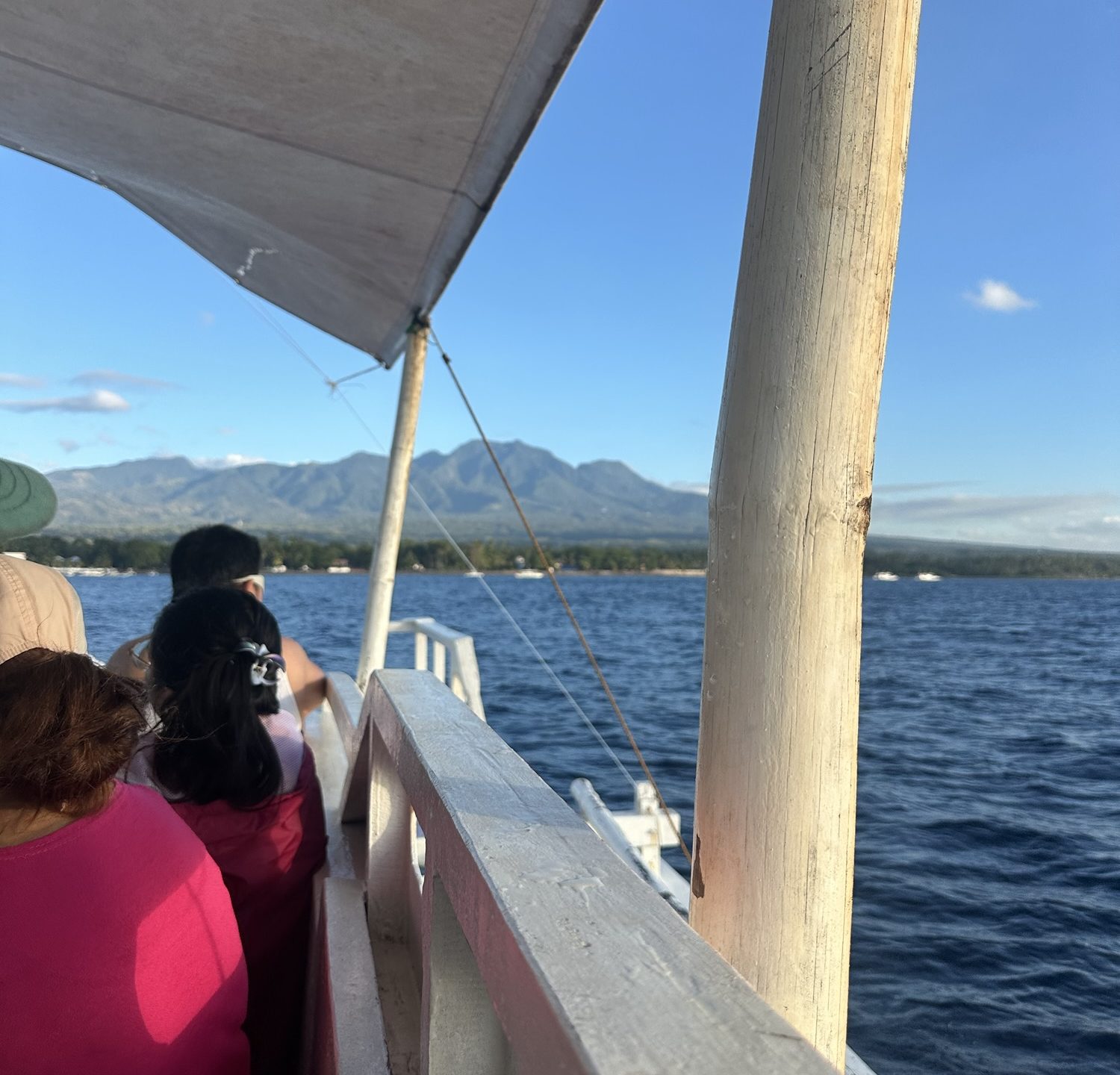
We set off at 6am from Apo island and arrived at Malatapay Wharf about 30 minutes later. This is slightly south of the city of Dumaguete. From here you must ignore the tuk tuk drivers that want to take you to Dumaguete for an inflated price. Elnor told us some horror stories of how much they sometimes charge tourists. But she is a sassy queen and I love how she asked the tourists to tell her who it was and then she told them off. They probably did do it again, the opportunistic tuk tuk mafia, but I love that she tries.
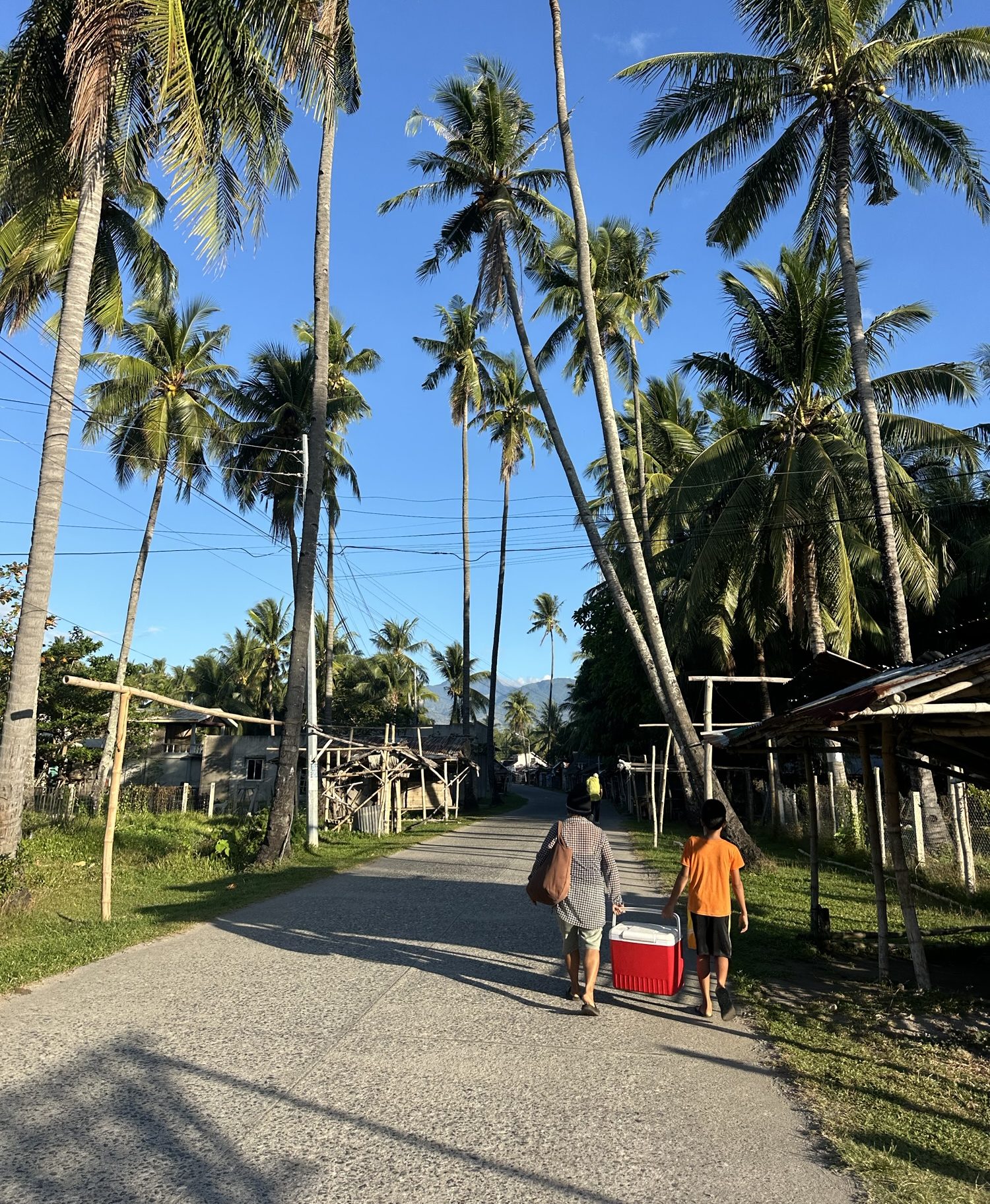
From here you walk down the main road to where the 7-eleven is. This is where you wait to hail down a jeepney. If this is your first time in one of these then you are about to have a unique locals experience.

The long wagon type buses are originally from the world war and are now used across the Philippines as their equivalent to public buses. I would recommend using them in any of the cities in the Philippines just for the fun of it at least once. Google maps is useful as it will sometimes show you the number to get on (just like any normal public bus systems).
There might be locals around that will help, if you simply ask to get to Dumaguete city. If not just flag down a jeepney – you are on the right side of the road as you walk up from the ferry port so don’t cross the road. Some jeepney drivers speak English but if not, they try their best and I am sure most will understand Dumaguete city.
It is about 30 minutes from here to get into the city centre. If you can get off near the Dumaguete Public Market this is best. If you have time, you can explore here and grab some food. It has a lively atmosphere, even so early in morning when we were there. From here we were dropped by lovely Elnor at the corner of Katada Street and Bishop Epifanio Surban St. The location is pinned here, as it doesn’t have a official bus stop sign on google maps.
Here you want to get on another jeepney going to Sibulan ferry terminal. Have this saved on your phone so you can show the drivers to check you are getting on the right jeepney.
This ride cost about a pound for both of us, but we were with a local so just keep this in mind when you are told a price. They will charge you extra for big bags, again not a lot. In our experience across the Philippines, jeepney drivers are very honest when it comes to pricing. You should then arrive at Sibulan ferry terminal.
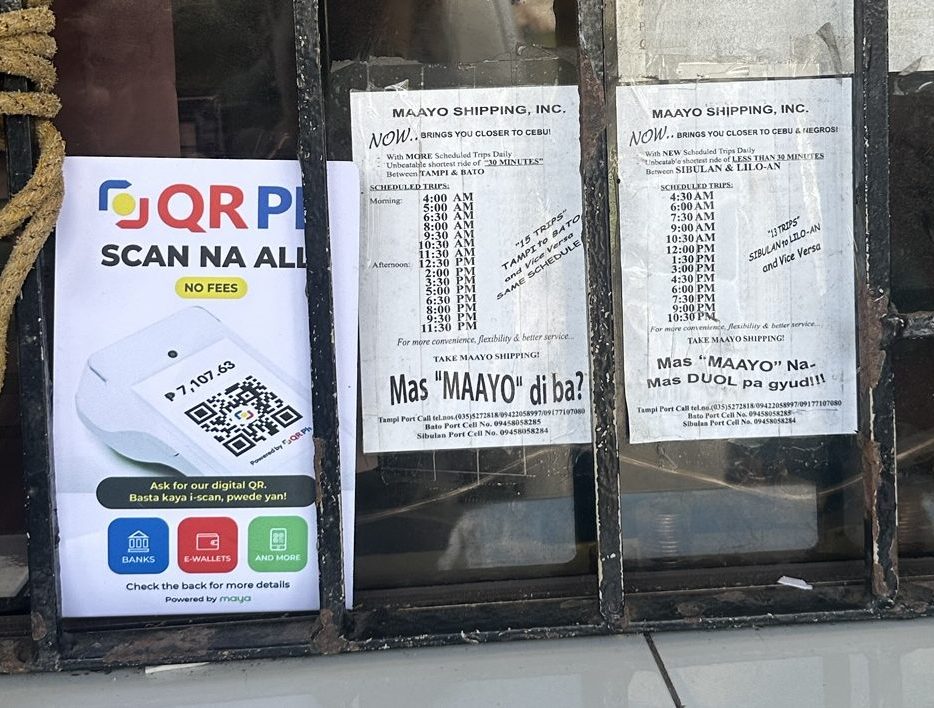
I have taken a picture of the timetable below but the ferries are basically every hour and a half from 4:30am to 10:30pm. Tickets can be purchased at the counter and then you simply head down and onto the ferry. The views are beautiful and your next stop will be back on Cebu island at Liloan ferry terminal. The ferry cost us 280 pesos (£3.45) for both of us.
Again there will be the usual tuk tuk drivers offering to take you to the bus terminal called Bato bus terminal. They will tell you there is no other way to get there, but there is. You must walk up the road to the intersection of the junction with the main road. Here you must just wait for a big green Seres liner bus to come by and wave them down. This was the longest part of the journey as several tuk tuk drivers said there was no bus and the first few buses refused to stop for us. Eventually a bus did stop and they dropped us off at Bato bus station just down the road, for 20 peso (25p) each. The driver spoke good English so then helped us point us towards our next bus to finally reach Moalboal – this journey is a few hours and cost 230 pesos (£2.84) (both of us). There is a toilet here if you need before you sit on a bus for several hours, there is no stop before Moalboal.
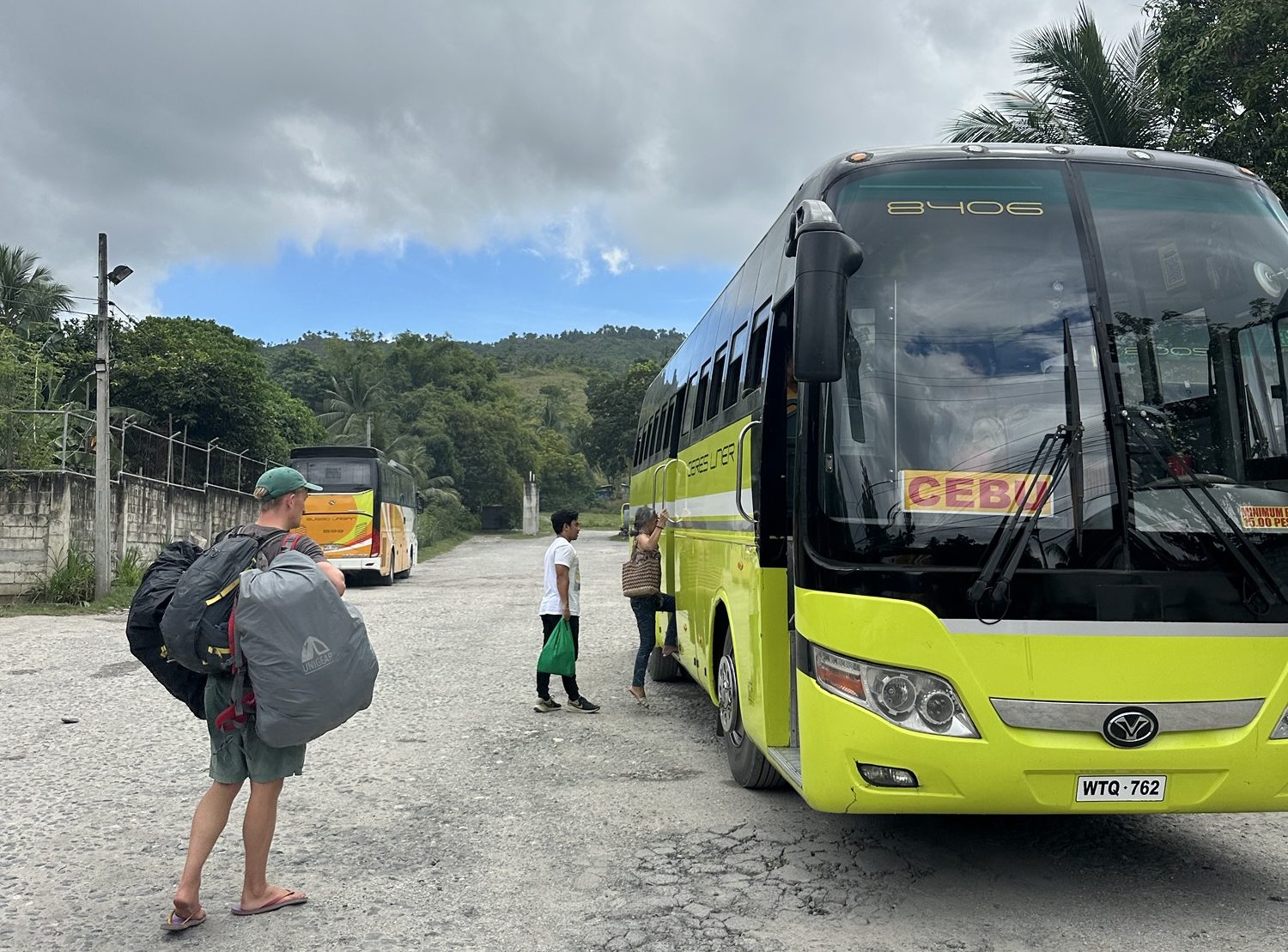
Top tip – keep an eye out for taxi drivers who are going back to Moalboal. Some people get private transfers to this ferry port (Liloan) from Moalboal, these drivers are then going back to Moalboal essentially for free. Therefore, you have an advantage in bartering. We think all in all it would have been cheaper for us to go with the taxi. However, if you are solo then the above is cheaper. Plus, if you can avoid the expensive tuk tuk ride below then the bus route is cheaper again.

Alternatively, if you wanted to go to Cebu and not Moalboal from Apo then you don’t need to go to Bato bus station and you can just board the bus with ‘Cebu’ on the front from the intersection near the ferry – this bus will be going the opposite way than Bato and Moalboal. A bit confusing but they both go back to Cebu but go different routes. One (the one we got) goes up the west side of the island past Moalboal and the other goes up the east side past Oslob.
The bus ride was very scenic along the coast, just prepare for some speedy corners – a driving technique common across Asia. On this route you go past Kawasan falls where you go canyoneering (the most popular and viral thing to do in Moalboal and arguably the Philippines). If you don’t want to stay in Moalboal, which in my opinion is very overpriced and over touristy, with the only attraction being the sardine run (which wasn’t my favourite) then I would stay near here. Just ask the bus driver to drop you off. This way you can get to Kawasan falls as early as possible to beat the crowds and there are some lovely beaches along here that are so much quieter than those near Moalboal centre.
When you arrive in Moalboal the bus drops you off outside the main tourist hub, therefore you must get a tuk tuk to your hotel from here. As we have learnt the standard price for this trip is 200 peso (£2.47) (this is what they charged us for the return leg), but the tuk tuk drivers when we first got off the bus started at 300 peso (£3.70). We ended up paying 220 but for only a 10 minute drive it is expensive (by local standards). After an in depth chat with one of the tuk tuk drivers on the way back when we left Moalboal, I did feel a bit sorry for them as he said there is so many drivers that they only get to do one or two rides a day which is less than £5 a day without fuel costs etc.
This bus stop which you get dropped off at (google maps link) is where you can get the bus back to Cebu from. Just turn up and ask for the next one, they are very regular. This cost us 420 pesos (£5.18) for both of us, to go from Moalboal to Cebu.
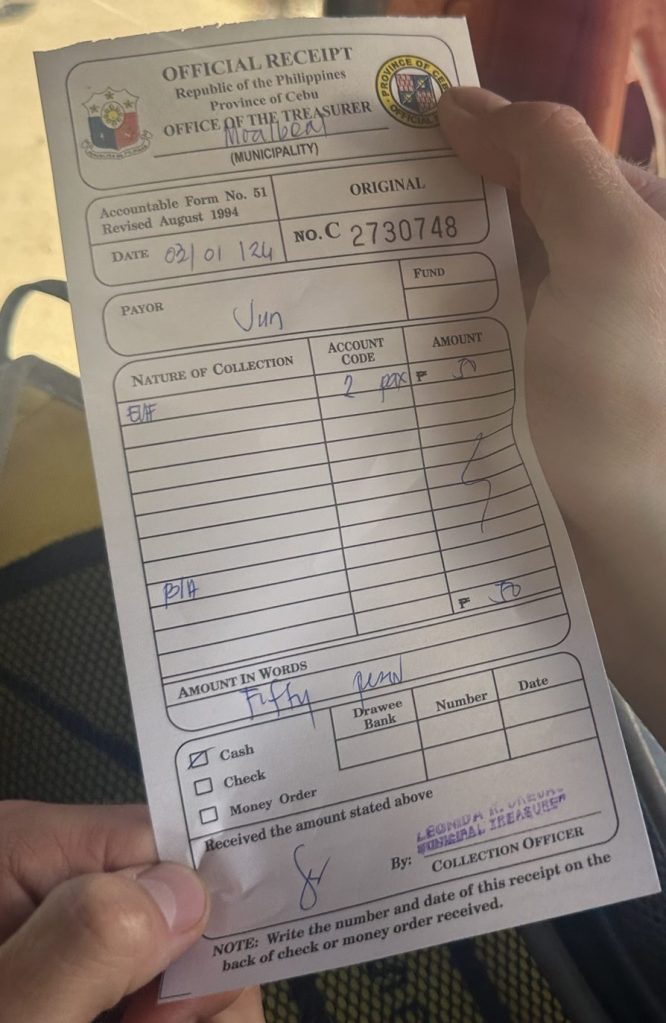
Be aware if you are travelling into Molaboal in a tuktuk they will take you via the environmental fee desk, supposedly all visitors must pay this fee when entering Moalboal. You will be given this recipt to keep and show if you are asked again, although we were never asked again when we were on our mopeds.
And there you have it, you have arrived at your final destination – Moalboal.
 The Travelling Paige
Leave a comment